Texas Soul. Lancashire bones. Proper BBQ you can smell from the road.Find your way to Henry’s ↗
Smoke & Stories

Lockhart Texas BBQ Pilgrimage

By Lee Hughes

From the Henry’s Smokehouse photo collection

Getting locked in at Lockhart TX – The BBQ Capital of the world – Part of our Texas BBQ Pilgrimage. How this lit the fire further for what is one of the greatest cuisines on the planet.

As the owner of Henry’s Smokehouse in Preston — Lancashire’s only proper offset-smoker BBQ joint doing it the old-school way — I’ve chased real barbecue (especially Texas & Southern) what feels like my whole life. It started modestly with Anthony Bourdain in the early 2000s, that madman who taught us all that food is stories on a plate. It was a time his stories mirrored a world that was very much my life for a while and I’ll always remember my first reading of Kitchen Confidential and later his adventures with BBQ -’Barbecue may not be the road to world peace, but its a start’ Anthony Bourdain. It became an obsession, though after Bourdain’s tragic passing, the day I learned about my grandfather, the all-American Army veteran who served in Vietnam and later pinned on a sheriff’s badge. Not because it was his favourite food, but because it is quintessentially American to it’s core and in it’s charm always brought families together, whether in real time or those that have passed. The fire was truly lit. Low and slow, real hardwood, no gas, no shortcuts. That obsession dragged me 5,000 miles to Lockhart — the undisputed BBQ Capital of the World — to taste the source and bring every lesson home to Lancashire. If you’re hunting authentic Texas-style BBQ in the UK, here’s exactly what Lockhart taught me about running a proper smokehouse and added to a journey I’m nowhere near done with yet.

Arriving in Lockhart: The Historic Square That Feels Like Coming Home

Lockhart sits just south of Austin like a time capsule. The whole town orbits the stunning Caldwell County Courthouse square — tree-lined lawns, old benches, and buildings that whisper stories. I wandered past the Chamber of Commerce, little cafés, antique shops, and artisan spots selling Texas souvenirs, breathing in small-town pride. This wasn’t just sightseeing. For a bloke running a family-owned authentic smokehouse in Preston, it was the perfect warm-up. Tradition and community aren’t marketing words here — they’re the air itself. You breathe it in without even a thought.

The Grand Courthouse: A Cathedral-Like Landmark That Stops You Cold

That red-and-yellow stone beast built in 1894 dominates everything. Second Empire style, clock tower, ornate domes — from a distance it looks more like a cathedral than a courthouse. I stood there staring at the arched windows and mansard roof, feeling the weight of Texas history on my shoulders. It’s the kind of place that makes you straighten your back and remember why you came.

Paying Respects at the Veterans Memorial: A Personal Connection That Hit Hard

Right in the square stands the Caldwell County Veterans Memorial — granite pillars, every branch emblem carved deep, and that simple line: “A Tribute to All Veterans Who Served This Great Nation And To Those Who Paid The Supreme Sacrifice For Freedom.” I knelt there thinking of my late grandad, the Army officer turned sheriff. Thought of my own Navy days and the rest of my family that served or are still serving in the US & UK forces. In a town that wears its heritage like a badge, that moment grounded everything. This trip wasn’t just about brisket. It was about honouring the people who built the fire before us.

Kreuz Market & Smitty’s: The Legendary Pit Split and the Purest Smoke on Earth

From the square I followed my nose straight to Kreuz Market (est. 1900). The whole walk there a vulture circled lazily overhead against that endless Texas blue sky — wings wide, riding the thermals like it already smelled

the post oak smoke and knew exactly where the real fire was waiting. It felt like the bird was guiding me straight to the pits.

No sauce, no forks, no plates — just butcher paper, a knife, and your hands. Massive brick pits roaring with post oak, flames you can feel on your face from ten feet away. Their handmade garlic sausages burst when you bite them; the ribs pull apart like they’ve been waiting for you your whole life.

Then the story gets proper Texas dramatic. In 1999 the Schmidt family split over a lease — Rick kept Kreuz down the street, Nina (now Schmidt) stayed in the original building and called it Smitty’s. Two legends born from one fire. But here’s the beautiful bit: as of 2025 the family has reconciled and the legacy is stronger than ever.

Smitty’s still runs on nothing but hardwood coals — no gas, no electricity — in pits that have burned since 1900. Walls black with decades of smoke, vintage Coke signs, the heat radiating like a forge. Same sausages, same purity. Both places reminded me why we refuse to cut corners at Henry’s Smokehouse: real offset smoking isn’t a trend, it’s a blood oath.

Henry’s Restaurant Lockhart: The Namesake Surprise That Made Me Laugh Out Loud

Wandering back across the square I spotted it — Henry’s American Restaurant at 215 S Commerce St. Same name as my Preston smokehouse (named after my boy-the only boy amongst a tribe of 6 daughters). I had to stop. Ordered the giant Henry’s burger — stacked, juicy, proper American — and the staff treated me like I’d been coming in for years. Established 2004, hardwood floors, brick walls, families laughing. It felt like a sign. I often say at Henry’s there’s a seat at the table for everyone – here it felt exactly the same.

Black’s Barbecue: Brisket, Mac ’n’ Cheese & Meeting the Queen of Texas BBQ

I saved the best for last. Black’s (family-run since 1932) delivered the brisket I’d been dreaming about — perfect smoke ring, bark like dark chocolate, melt-in-the-mouth tender. Creamy mac ’n’ cheese on the side, the kind that makes you close your eyes. But the real moment? Meeting Norma Jean Black herself — the matriarch, the “Queen of Texas BBQ,” now in her early 90s and still sharp as a knife. You learn a lot about someone when you a share a table or meal with them. Sitting across from her, I learned something about her soul. She invented their famous pinto beans and that tangy sauce back in the 1940s. We sat there over tender brisket and talked families, loss, real hospitality, and the decades she’d spent in those pits. Her warmth hit harder than the smoke ever could. She gave me ideas I’m already bringing back to Preston, UK. But more than anything, she reminded me that the best barbecue isn’t just meat on butcher paper — it’s the people who keep the fire going. The stories we carry forward. The way we can all relate to loss when we sit around a table together. The way Norma Jean spoke of her late husband, after nursing him through his long illness, it struck me right in the chest. The loss of someone you love is a hole very hard to understand or navigate. The love, adoration and respect still burning in her voice after all these years. You can’t help but think… I hope someone would talk so fondly of me when my time comes. People who give you their time like that should be appreciated. Folks like Norma Jean — they’re the real icing on the cake.

What Lockhart taught us I came home with three lessons burned into my soul:

1. Purity matters — post oak, butcher paper, no sauce needed if the smoke is right. 2. Fire is family — real offsets connect generations (my grandad, my boy Henry, your table in Preston). 3. BBQ pulls people together better than anything else I’ve cooked in 20+ years. In Creole cooking you feed the living and honour the spirits. In Texas barbecue you feed everyone who walks through the door and hope they leave a little more whole That’s exactly what we do at Henry’s Smokehouse in Preston — Lancashire’s premier offset-smoker spot serving authentic Texas-style barbecue the way it was meant to be.

Lockhart isn’t just a town. It’s a masterclass. And every time someone in Preston bites into our brisket and smiles, I’m right back in that post-oak haze, grateful as hell. And the journey never stops

– More BBQ Adventures Loading..
Keep the fire going

More Smoke & Stories.

Smoke & Stories

Healthier Smokes: Nutritional Benefits of Low-and-Slow BBQ at Lancashire’s Only Authentic Texas-Style Smokehouse

By Lee Hughes

From the Henry’s Smokehouse photo collection

At Henry’s Smokehouse in Greenhalgh, we’re passionate about delivering that true Southern-inspired BBQ experience right here in Lancashire. As Lancashire’s only authentic Texas-style smokehouse, our family-run smokehouse takes pride in an approach to smoking meats that isn’t just about cooking—it’s about craftsmanship, tradition, and creating flavours that tell a story. Today, we’re pulling back the curtain on our smoking process, comparing our hands-on method using offset smokers and real wood logs to the more automated “push-and-play” systems often seen in larger chain restaurants. We’ll explore the differences constructively, highlighting how our artisanal Texas-style BBQ using offsets sets us apart and why it might just make your next bite unforgettable.

Understanding the Basics: Offset Smokers vs. Push-and-Play Systems in Texas-Style BBQ

Let’s start with the fundamentals. An offset smoker is a classic design where the firebox is separate from the cooking chamber—perfect for the low-and-slow cooking that defines authentic Texas-style BBQ. We build a fire using real wood logs—think hickory, oak, or applewood sourced from trusted suppliers—and the smoke and heat travel horizontally into the chamber where the meats rest. It’s a bit like conducting an orchestra: you have to monitor the fire, adjust vents for airflow, and maintain consistent temperatures over hours (or even days for our signature brisket). This hands-on involvement requires skill and experience, but it allows for nuanced control over the smoke’s intensity and flavour profile, making Henry’s Lancashire’s only authentic Texas-style smokehouse truly stand out.

On the other hand, many big-brand chains opt for push-and-play smokers, which are often pellet-fed, electric, or gas-powered units. These are designed for efficiency: you load pellets (compressed wood sawdust), set a temperature on a digital controller, and let automation handle the rest. It’s like popping something in the microwave—reliable, quick to learn, and consistent across multiple locations. These systems shine in high-volume settings where predictability is key, ensuring every outlet delivers the same product without much variation.

Both methods have their place in the BBQ world. Push-and-play setups are fantastic for scalability, making it easier for chains to maintain quality control and train staff quickly. But at Henry’s, Lancashire’s only authentic Texas-style smokehouse, we embrace the offset method because it aligns with our ethos of creating something truly unique and soulful through traditional Texas-style BBQ using offsets.

The Flavour Factor: Depth and Complexity from Real Logs in Authentic Texas-Style BBQ

One of the biggest differences comes down to the smoke itself. With real wood logs in an offset smoker, the combustion process is natural and variable—essential for that genuine Texas-style BBQ flavour. The logs burn at different rates, releasing a spectrum of compounds that infuse the meat with layers of flavour—smoky, sweet, earthy notes that evolve throughout the cook. For example, our grain-fed brisket spends up to 14 hours absorbing these aromas, resulting in a bark that’s crispy and caramelised, with tender, juicy interiors that burst with authenticity. Some of our best results have been from smoking brisket with cherry and post oak for that exceptional bark and purple ring, where the cherry adds a subtle fruity sweetness and the post oak delivers a clean, mellow smoke that enhances the natural beef flavours without overpowering them.

Push-and-play systems, while convenient, often use uniform pellets that produce a cleaner, more consistent smoke. This can lead to reliable results, but it sometimes lacks the depth you get from burning whole logs in Texas-style BBQ using offsets. The automation minimises the “human touch,” which can make the end product feel more standardised—great for a chain aiming for uniformity across hundreds of stores, but less so for those seeking that one-of-a-kind taste at Lancashire’s only authentic Texas-style smokehouse.

We choose real logs because they allow us to experiment and refine our recipes based on the season, the wood’s moisture content, or even the weather outside. It’s this variability that makes each batch at Henry’s a little artisanal masterpiece, reflecting our family’s dedication rather than a corporate formula.

Craftsmanship and Sustainability: The Human Element in Texas-Style BBQ Using Offsets

Running an offset smoker isn’t easy—it demands constant attention to avoid temperature spikes or flare-ups that could ruin a cut of meat. But that’s precisely why we love it at Lancashire’s only authentic Texas-style smokehouse. Our pitmasters (often family members or long-time team) bring years of expertise to the process, tweaking based on feel and intuition. This artisanal approach fosters a sense of pride and connection, turning smoking into an art form rather than a task.

In contrast, push-and-play systems prioritise ease and speed, which is ideal for big brands handling massive operations. They reduce labour costs and minimise errors, allowing chains to focus on volume and expansion. It’s a smart business model for them, but it can sometimes distance the food from its roots.

At Henry’s, our method also ties into sustainability. We source logs from local, responsibly managed forests, ensuring minimal waste and supporting Lancashire’s economy. Real logs mean we’re using natural, renewable resources without the processing involved in pellets, which aligns with our commitment to quality over quantity in Texas-style BBQ using offsets.

Why It Matters for Your Dining Experience

So, why go the extra mile with offset smokers and real logs? For us, it’s about delivering an experience that’s as unique as our guests. In a world of fast-casual chains, our style offers a refreshing contrast—meats with character, flavours that surprise and delight, and a story behind every plate. Whether you’re enjoying our pulled pork during happy hour or a full rack of ribs at a family gathering, you’re tasting the passion that automated systems just can’t replicate at Lancashire’s only authentic Texas-style smokehouse.

That said, we respect the innovation in push-and-play tech; it’s made BBQ more accessible to everyone. But if you’re craving something artisanal, heartfelt, and distinctly Henry’s, our traditional method is where the magic happens.

Come Taste the Difference

Ready to experience authentic smokehouse flavours? Swing by Henry’s Smokehouse in Greenhalgh—Lancashire’s only authentic Texas-style smokehouse—for our daily specials, or book a table for your next visit. Follow us on Instagram for behind-the-scenes peeks at our offset smokers in action.

Henry’s Smokehouse: Where Smoke Meets Soul.

Keep the fire going

More Smoke & Stories.

Smoke & Stories

The Art of Authentic Smoking: Why Lancashire’s Only Authentic Texas-Style Smokehouse Sticks to Offset Smokers and Real Logs

By Lee Hughes

From the Henry’s Smokehouse photo collection

At Henry’s Smokehouse in Greenhalgh, we’re passionate about delivering that true Southern-inspired BBQ experience right here in Lancashire. As Lancashire’s only authentic Texas-style smokehouse, our family-run smokehouse takes pride in an approach to smoking meats that isn’t just about cooking—it’s about craftsmanship, tradition, and creating flavours that tell a story. Today, we’re pulling back the curtain on our smoking process, comparing our hands-on method using offset smokers and real wood logs to the more automated “push-and-play” systems often seen in larger chain restaurants. We’ll explore the differences constructively, highlighting how our artisanal Texas-style BBQ using offsets sets us apart and why it might just make your next bite unforgettable.

Understanding the Basics: Offset Smokers vs. Push-and-Play Systems in Texas-Style BBQ

Let’s start with the fundamentals. An offset smoker is a classic design where the firebox is separate from the cooking chamber—perfect for the low-and-slow cooking that defines authentic Texas-style BBQ. We build a fire using real wood logs—think hickory, oak, or applewood sourced from trusted suppliers—and the smoke and heat travel horizontally into the chamber where the meats rest. It’s a bit like conducting an orchestra: you have to monitor the fire, adjust vents for airflow, and maintain consistent temperatures over hours (or even days for our signature brisket). This hands-on involvement requires skill and experience, but it allows for nuanced control over the smoke’s intensity and flavour profile, making Henry’s Lancashire’s only authentic Texas-style smokehouse truly stand out.

On the other hand, many big-brand chains opt for push-and-play smokers, which are often pellet-fed, electric, or gas-powered units. These are designed for efficiency: you load pellets (compressed wood sawdust), set a temperature on a digital controller, and let automation handle the rest. It’s like popping something in the microwave—reliable, quick to learn, and consistent across multiple locations. These systems shine in high-volume settings where predictability is key, ensuring every outlet delivers the same product without much variation.

Both methods have their place in the BBQ world. Push-and-play setups are fantastic for scalability, making it easier for chains to maintain quality control and train staff quickly. But at Henry’s, Lancashire’s only authentic Texas-style smokehouse, we embrace the offset method because it aligns with our ethos of creating something truly unique and soulful through traditional Texas-style BBQ using offsets.

The Flavour Factor: Depth and Complexity from Real Logs in Authentic Texas-Style BBQ

One of the biggest differences comes down to the smoke itself. With real wood logs in an offset smoker, the combustion process is natural and variable—essential for that genuine Texas-style BBQ flavour. The logs burn at different rates, releasing a spectrum of compounds that infuse the meat with layers of flavour—smoky, sweet, earthy notes that evolve throughout the cook. For example, our grain-fed brisket spends up to 14 hours absorbing these aromas, resulting in a bark that’s crispy and caramelised, with tender, juicy interiors that burst with authenticity.

Push-and-play systems, while convenient, often use uniform pellets that produce a cleaner, more consistent smoke. This can lead to reliable results, but it sometimes lacks the depth you get from burning whole logs in Texas-style BBQ using offsets. The automation minimises the “human touch,” which can make the end product feel more standardised—great for a chain aiming for uniformity across hundreds of stores, but less so for those seeking that one-of-a-kind taste at Lancashire’s only authentic Texas-style smokehouse.

We choose real logs because they allow us to experiment and refine our recipes based on the season, the wood’s moisture content, or even the weather outside. It’s this variability that makes each batch at Henry’s a little artisanal masterpiece, reflecting our family’s dedication rather than a corporate formula.

Craftsmanship and Sustainability: The Human Element in Texas-Style BBQ Using Offsets

Running an offset smoker isn’t easy—it demands constant attention to avoid temperature spikes or flare-ups that could ruin a cut of meat. But that’s precisely why we love it at Lancashire’s only authentic Texas-style smokehouse. Our pitmasters (often family members or long-time team) bring years of expertise to the process, tweaking based on feel and intuition. This artisanal approach fosters a sense of pride and connection, turning smoking into an art form rather than a task. In contrast, push-and-play systems prioritise ease and speed, which is ideal for big brands handling massive operations. They reduce labour costs and minimise errors, allowing chains to focus on volume and expansion. It’s a smart business model for them, but it can sometimes distance the food from its roots.

At Henry’s, our method also ties into sustainability. We source logs from local, responsibly managed forests, ensuring minimal waste and supporting Lancashire’s economy. Real logs mean we’re using natural, renewable resources without the processing involved in pellets, which aligns with our commitment to quality over quantity in Texas-style BBQ using offsets.

Why It Matters for Your Dining Experience

So, why go the extra mile with offset smokers and real logs? For us, it’s about delivering an experience that’s as unique as our guests. In a world of fast-casual chains, our style offers a refreshing contrast—meats with character, flavours that surprise and delight, and a story behind every plate. Whether you’re enjoying our pulled pork during happy hour or a full rack of ribs at a family gathering, you’re tasting the passion that automated systems just can’t replicate at Lancashire’s only authentic Texas-style smokehouse.

That said, we respect the innovation in push-and-play tech; it’s made BBQ more accessible to everyone. But if you’re craving something artisanal, heartfelt, and distinctly Henry’s, our traditional method is where the magic happens.

Come Taste the Difference

Ready to experience authentic smokehouse flavours? Swing by Henry’s Smokehouse in Greenhalgh—Lancashire’s only authentic Texas-style smokehouse—for our daily specials, or book a table for your next visit. Follow us on Instagram for behind-the-scenes peeks at our offset smokers in action.

Henry’s Smokehouse: Where Smoke Meets Soul.

Keep the fire going

More Smoke & Stories.

Smoke & Stories

The Smoky Legacy: A History of Meat Smoking in the US, with a Focus on Texas Traditions and Our Family’s Obsession at Henry’s Smokehouse

By Lee Hughes

From the Henry’s Smokehouse photo collection

At Henry’s Smokehouse in Greenhalgh, Lancashire’s only authentic Texas-style smokehouse, our passion for low-and-slow smoked meats runs deep—rooted in family heritage, transatlantic ties, and an unyielding commitment to tradition. As we fire up our offset smokers with real wood logs like mesquite, cherry, apple, and post oak, we’re not just cooking; we’re honouring a centuries-old craft that has evolved across the United States. In this blog, we’ll trace the history of smoking meats in the US, spotlighting Texas’s iconic role, weave in our own family’s story and obsession, and celebrate legendary chefs who’ve journeyed to immerse themselves in this cuisine. We’ll also dedicate a section to the late Anthony Bourdain, whose love for BBQ captured its soulful essence, and explore how his insights resonate with our personal journey through loss and connection.

The Origins and Evolution of Smoking Meats Across the US

The art of smoking meats in the United States predates European settlement, with roots in Indigenous practices that date back before the 1500s. Native American tribes across regions like the Southeast and Southwest used smoke from open fires or earth pits to preserve and flavour game, fish, and other proteins, turning necessity into a culinary foundation. This technique—slow-cooking over indirect heat with wood smoke—helped combat spoilage in a pre-refrigeration era, infusing meats with rich, earthy notes from local woods.

As European settlers arrived, they blended these methods with their own traditions. In the Carolinas, for instance, whole-hog barbecues emerged in the 1600s, influenced by English roasting and African American innovations from enslaved people who brought spice rubs and vinegary sauces. The Midwest saw German immigrants introduce sausage smoking in the 1800s, while the Memphis style focused on ribs with sweet, tomato-based sauces.

But it’s in Texas where smoking meats truly became an icon. Central Texas barbecue evolved in the mid-1800s from German and Czech immigrants who settled the region, bringing European meat-smoking techniques to preserve beef leftovers in their butcher shops. They used post oak wood for its clean burn, creating the low-and-slow style that defines Texas BBQ today—brisket, sausages, and ribs rubbed simply with salt and pepper, smoked for hours in offset pits. Indigenous influences from earth-oven cooking and Spanish settlers’ open-flame methods added layers, while the cattle boom of the Old West made beef the star. By the early 1900s, Texas BBQ had become a community ritual, from church picnics to market days, evolving into the four regional styles: Central (beef-focused, simple rubs), East (chopped meats with sauce), South (barbacoa influences), and West (mesquite-smoked cowboy style).

This history isn’t just about food—it’s about cultural fusion, survival, and celebration, turning humble preservation into a national treasure.

Our Family’s Transatlantic Ties and Obsession with Texas-Style Smoking

Our story at Henry’s is deeply intertwined with this American legacy, fuelled by personal heritage and a relentless pursuit of authenticity. Founded by pit boss Lee Hughes, a UK-born award-winning chef from a forces family, our smokehouse channels transatlantic threads from the US and UK armed forces. Lee’s grandad, a US Army veteran who became a respected sheriff, embodied resilience and service before his tragic suicide—an untimely passing that left a profound void but also a legacy of quiet strength that echoes through our generations.

This legacy of resilience has shaped our own family ethos: finding happiness through service, no matter the hardships. It led to our Queen’s Award for Voluntary Service in 2019, recognising efforts to feed those in need in Manchester, including homeless veterans—something close to our hearts. We’ve channelled this connection into an obsession with Texas-style smoked BBQ, honed from years in UK kitchens working with top chefs and restaurateurs. Named after our only son Henry in a bustling family of seven kids, our smokehouse is a tribute to honest food that brings people together.

What obsesses us? The challenge of perfection amid variables. Our brisket and meats spend 12-18 hours in traditional offset smokers, fuelled by real logs like mesquite for bold earthiness, cherry for sweet notes, apple for fruity brightness, and post oak for mellow balance. Unlike chains with set-and-forget machines or pre-smoked frozen meats, we battle UK rain, wind, and chills to craft limited batches with soul—gone viral on social media. It’s this raw, obsessive vibe that fosters unity over shared plates, echoing the endurance in our family story and the Texas traditions we revere.

Legendary Chefs Who Ventured to the US for BBQ Enlightenment

The allure of American BBQ, especially Texas-style smoking, has drawn legendary chefs from around the world to pilgrimage across the US, seeking to understand its smoky secrets. Canadian chef Roger Mooking, host of Cooking Channel’s “Man Fire Food,” has traveled extensively through the States, exploring pitmasters’ techniques from whole-hog roasts in the Carolinas to brisket in Texas, sharing how fire and smoke create unforgettable flavours.

American-born but globally influential Steven Raichlen, author and PBS host of “Primal Grill,” has ventured deep into US BBQ regions, learning from Texas pitmasters about offset smoking and wood selection, which he incorporates into his worldwide barbecue explorations. Pitmaster Rodney Scott, featured on Netflix’s “Chef’s Table: BBQ,” journeyed from his South Carolina roots to collaborate with Texas experts, mastering whole-hog and brisket to blend styles in his restaurants.

Even international figures like UK chef Heston Blumenthal have expressed fascination, though more through inspiration—venturing conceptually to recreate BBQ elements in molecular gastronomy. These chefs’ journeys highlight BBQ’s universal appeal, drawing them to the US for hands-on lessons in patience, smoke, and community.

Anthony Bourdain: A Champion of BBQ’s Soulful Power and Its Resonance with Our Story

No discussion of BBQ’s cultural impact is complete without Anthony Bourdain, the late chef, author, and traveler whose raw enthusiasm for Texas-style smoking captured its essence. Bourdain visited Texas multiple times for his shows like “No Reservations” and “Parts Unknown,” queuing at iconic spots like Franklin Barbecue in Austin and exploring Houston’s pits, praising the “special” authenticity of Texas BBQ.

Why did he love it? Bourdain saw BBQ as more than food—it was a connector, fostering community and humility in unpretentious settings where stories unfold over shared plates. In Texas, he admired the no-frills approach: simple rubs, long smokes, and the pitmaster’s dedication, which mirrored his own ethos of genuine experiences over pretension. He famously said, “Barbecue may not be the road to world peace, but it’s a start,” encapsulating how shared meals bridge divides—a sentiment that resonates with our own mission at Henry’s. Bourdain’s explorations inspired global appreciation, proving BBQ’s power to unite through flavour and stories.

For us, Bourdain’s story hits even closer to home, intertwined with the tragedy of my granddad’s passing. Much like Bourdain’s own battles with demons that he channeled into raw, honest storytelling. Both narratives remind us of life’s fragility and the quiet heroism in perseverance. It’s why I’ve felt so profoundly that BBQ brings people together in that unfiltered vibe Bourdain thrived in: around a pit or table, barriers dissolve amid the smoke and sizzle. Conversations flow, laughter mends wounds, and for a moment, isolation fades. In our smokehouse, every brisket sliced is a nod to this—turning personal hardship into communal warmth, fostering connections that heal, just as Bourdain believed food could. It’s soulful alchemy: from ashes of loss to the glow of shared humanity.

Keep the fire going

More Smoke & Stories.

Smoke & Stories

The Texas Gold Standard Brisket: Achieving Bark, Purple Ring, and Wobble with Our Unique UK Offset Smoking Method

By Lee Hughes

From the Henry’s Smokehouse photo collection

At Henry’s Smokehouse in Greenhalgh, we’re committed to capturing the soul of authentic Texas-style BBQ in the heart of Lancashire. As one of only a few smokehouses in the UK using traditional offset smokers and real wood logs, we craft brisket that embodies the legendary “Texas gold standard”—that perfect harmony of crispy bark, vibrant purple smoke ring, and irresistible wobble. In this blog, we’ll explore what defines this gold standard, the historical significance of these markers in Texas smoking culture, and key steps to achieve them. We’ll also highlight how our almost unique method in the UK enhances these elements, delivering a brisket that’s tender, flavourful, and true to its roots.

What Defines the Texas Gold Standard Brisket?

The “Texas gold standard” brisket is the benchmark of BBQ excellence: a low-and-slow smoked cut that’s juicy, packed with deep smoky flavours, and structurally sublime. Originating from Texas’s rich BBQ heritage, it transforms a tough packer cut into something extraordinary through patience and skill. The key markers are:

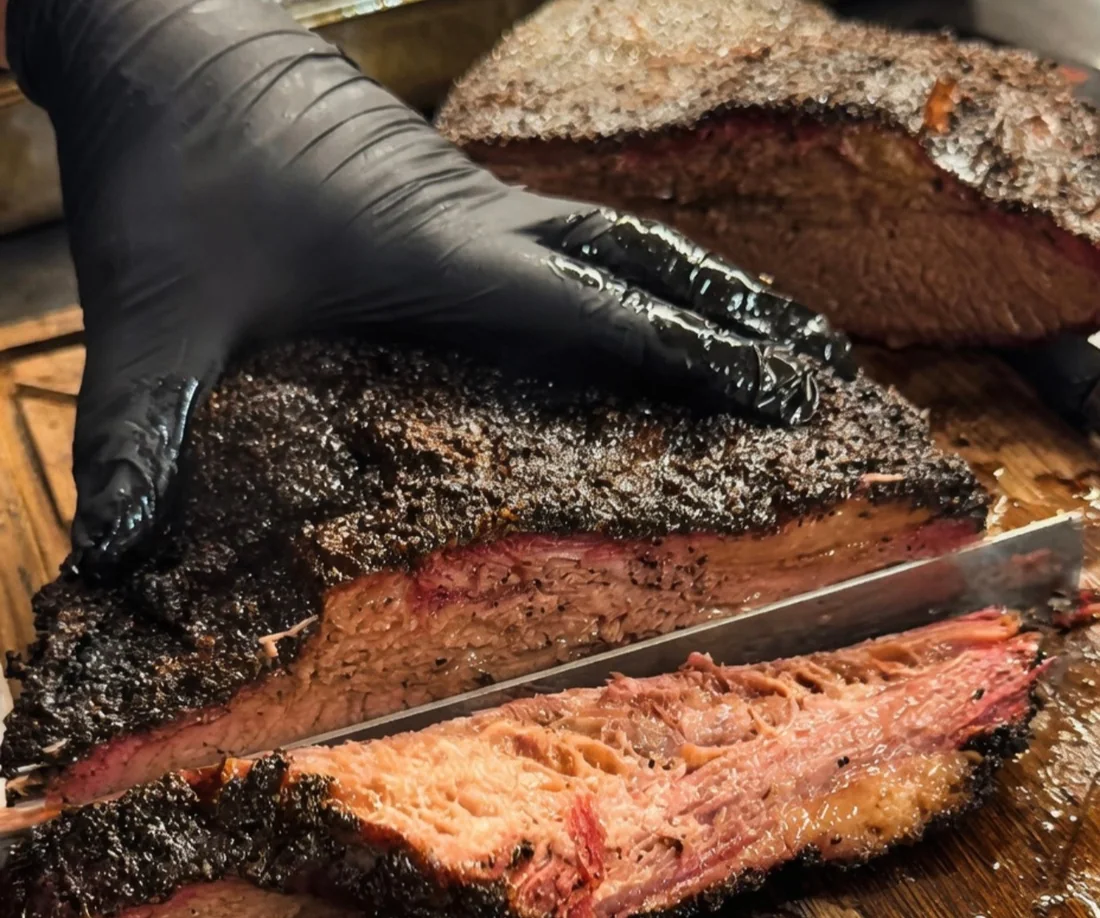
  • The Bark: A dark, caramelised crust formed by the rub interacting with smoke, heat, and rendered fats. It provides a textural contrast—crispy on the outside, locking in moisture while delivering intense, savoury notes.
  • The Purple Smoke Ring: A striking pink-to-purple band just beneath the bark, resulting from nitric oxide in wood smoke reacting with the meat’s myoglobin. It’s a visual testament to proper smoke penetration, enhancing juiciness and flavour depth.
  • The Wobble: The ultimate sign of tenderness—when the brisket jiggles like jelly upon handling, indicating that connective tissues have fully broken down into gelatin, yielding a melt-in-your-mouth texture without dryness.

These elements aren’t just aesthetic; they’re proof of masterful craftsmanship in balancing time, temperature, and smoke.

The Historical Importance of These Markers in Texas Smoking

Texas BBQ traces its roots to the 19th century, influenced by Native American pit cooking, German and Czech immigrants’ sausage-making traditions, and the cattle drives of the Old West. Brisket emerged as a star in the mid-20th century, particularly in Central Texas, where butchers turned undervalued cuts into delicacies using offset pits and post oak wood.

The bark, smoke ring, and wobble have been revered for over a century as symbols of quality. The smoke ring, for instance, has been a prized indicator since the early days of wood-fired pits, dating back to the 1800s, when pitmasters gauged smoke absorption visually—long before science explained it as a myoglobin reaction in the 20th century. Bark formation was equally vital in frontier-style cooking, providing flavour and preservation during long cooks. The wobble, though less formally named historically, has always signified tenderness, a craft essential for transforming tough beef into tender gold during cattle drive eras.

These markers are crucial to the craft because they reflect the pitmaster’s expertise—no shortcuts allowed. In Texas, they’ve defined competitions, family traditions, and commercial success for generations, embodying the philosophy that great BBQ is about respect for the process, not just the product. Without them, a brisket might taste fine, but it lacks the soul that elevates it to legendary status.

Key Points in Achieving the Texas Gold Standard

Crafting this level of brisket demands precision and experience. Here are several essential steps we follow at Henry’s to hit those markers every time:

  • Selecting the Right Cut: Start with a high-quality full packer brisket (point and flat) for balanced fat distribution, ensuring even cooking and that signature wobble.
  • Simple Seasoning: Use a classic Texas rub—coarse salt, black pepper, and perhaps garlic—to allow the meat and smoke to shine, promoting bark formation without overpowering flavours.
  • Temperature Control: Maintain a steady 110-135°C in the offset smoker for 12-16 hours. This low-and-slow approach breaks down collagen for tenderness and the wobble, while allowing smoke to build the purple ring gradually.
  • Wood Selection: Choose real logs like post oak for a clean, mellow smoke and cherry for subtle sweetness—these enhance the bark’s caramelisation and deepen the smoke ring’s hue.
  • Wrapping with Butcher’s Paper and Adding Beef Tallow: Around the 8-10 hour mark, when the bark is set, wrap in breathable butcher’s paper to retain moisture without steaming. We add a generous dollop of rendered beef tallow here to boost juiciness, amplify the wobble, and prevent dryness in the flat end— a Texas technique that locks in flavours while finishing the cook.

These steps, honed over decades in Texas traditions, ensure consistency and excellence.

How Our Offset Smokers and Real Logs Enhance the Gold Standard – Almost Uniquely in the UK

In the UK, where automated pellet smokers and gas units dominate for convenience, Henry’s stands out as one of the few adhering to authentic offset smokers and real wood logs. This method directly elevates the Texas gold standard by providing variable, natural smoke that automated systems can’t match.

Our offsets allow precise airflow and heat management, crucial for developing a robust bark and deep purple ring without hot spots. Real logs—sourced responsibly—burn unevenly, releasing compounds that infuse complex flavours, far superior to uniform pellets. For example, combining cherry and post oak yields our best results: exceptional bark with fruity undertones and a pronounced purple ring that screams authenticity.

This hands-on approach, rare in the UK, mirrors Texas pits from the 19th century onward, demanding skill that builds character in every brisket. It enhances the wobble by allowing fats to render slowly, resulting in unparalleled tenderness. By shunning shortcuts, we preserve the craft’s integrity, offering Lancashire diners a true taste of Texas heritage.

Why It Matters for Your BBQ Experience

The Texas gold standard isn’t mere tradition—it’s a commitment to quality that turns a meal into a memory. These markers, vital for over 150 years, underscore the artistry of BBQ. At Henry’s, our unique method ensures you experience this craft at its finest, bridging Texas roots with UK innovation.

Come Savour the Gold Standard

Ready for brisket with that perfect bark, purple ring, and wobble? Visit Henry’s Smokehouse in Greenhalgh for our specials or events. Book a table today.

Keep the fire going

More Smoke & Stories.

Henry’s Holidays

Gather your people. Book your festive table.

The smokehouse fills up from now through Christmas. Get your date in.

Book now
A Henry’s Smokehouse sharing feast

Share with